

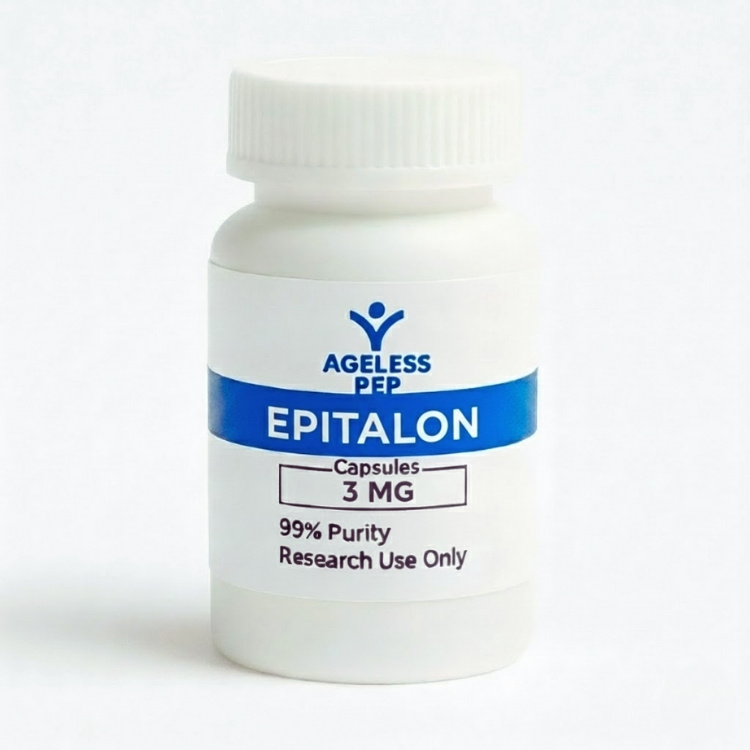
$148.35
Out of stock
$148.35
Suggested Research Protocol:
1 capsule daily
Supply Duration:
Each bottle contains a 60-day research supply when used as directed.
This product is intended for research and laboratory use only. Not intended for human consumption.
Epitalon is a synthetic tetrapeptide studied for its role in cellular aging mechanisms, gene expression regulation, and telomere biology. It has been widely referenced in longevity and epigenetics research models.
Epitalon has been investigated in multiple preclinical models for its interaction with telomerase activity and telomere structure. Published studies in animal models suggest that Epitalon may influence lifespan parameters by supporting chromosomal stability and cellular replication processes.
Additional research is exploring Epitalon’s role in epigenetic modulation, circadian rhythm regulation, and cellular signaling pathways associated with aging-related biological functions.
Based on preclinical and laboratory studies, Epitalon has been associated with:
Telomerase activation in cell cultures
Preservation of telomere length in animal models
Modulation of gene expression
Cellular senescence pathway regulation
These findings are investigational and are not intended to imply therapeutic use.
In research settings, Epitalon has demonstrated a favorable safety profile. However, reported observations in animal and laboratory models may include:
Mild gastrointestinal response
Temporary fatigue
Headache-like behavior markers
Proper laboratory handling procedures should be followed at all times.
Epitalon is used in laboratory and preclinical research to study mechanisms related to telomere biology, cellular aging, gene regulation, and epigenetic processes. It is also examined in circadian rhythm and oncology-related research models.
$148.35
Out of stock
Important: All peptides offered are intended for in-vitro and pre-clinical research only. Not for human use. Not approved by the US FDA for medical conditions.
Peptides are short chains of amino acids, typically under 50 residues, whereas proteins are much longer and fold into complex structures.
Because peptides are smaller, they tend to:
Bind more selectively to receptors
Have faster biological signaling effects
Be easier to synthesize and modify for research
This makes them ideal for targeted experiments in regeneration, metabolism, and cellular communication.
Ageless Pep provides high-purity, lab-tested research peptides.
The team is dedicated to scientific accuracy and excellent customer support.
The platform serves a community of researchers and scientists committed to innovation.
Depending on the study design, peptides can be researched through:
In-vitro assays
Animal models
Cell cultures
Subcutaneous or intravenous administration (in animals)
Each peptide behaves differently — for example, Semaglutide and Tirzepatide are studied via subcutaneous injections, while others like BPC-157 show effects even when administered orally or parenterally in rodent studies.
Peptides generally require:
Cool, dry storage when lyophilized
Refrigeration after reconstitution
Protection from UV light and temperature fluctuations
This preserves molecular integrity, preventing oxidation or breakdown of amino-acid chains.
Proper storage ensures reproducibility of experimental results.
Peptide bioavailability depends on:
Molecular weight
Receptor affinity
Use of fatty-acid modifications (e.g., Semaglutide’s di-acid component for long-acting effects)
PEGylation to extend half-life (e.g., PEG-MGF)
Route of administration
Enzyme resistance (e.g., BPC-157’s stability in gastric acid)
Peptides like Semaglutide and Tirzepatide activate GLP-1 and GIP receptors, influencing:
Appetite regulation
Insulin secretion
Gastric emptying
Blood glucose stabilization
Energy expenditure
Multiple clinical trials cited in the guide show significant reductions in HbA1c, body weight, and cardiometabolic markers
In recovery-related studies:
BPC-157 supports angiogenesis, tendon repair, and wound healing.
TB-500 promotes cell migration, vascular growth, and tissue regeneration.
MGF variants influence satellite cell activation and neuroprotection.
These mechanisms make peptides highly relevant in regenerative-medicine research models.